
So you want to become an interventional radiology tech or maybe you are just curious about what the job is really like? Either way, you have come to the right place. An interventional radiology tech (also called an IR tech or interventional radiology technician) works at the exciting intersection of medical imaging and minimally invasive procedures.
While most people have heard of X-rays or MRI scans, the world of Interventional Radiology Tech is far less talked about yet it saves thousands of lives every single day. In this guide, we go behind the scenes to show you exactly what happens in a real IR shift, from the moment you clock in to the moment you walk out the door.
What Is an Interventional Radiology Tech?
Before diving into the daily routine, it helps to understand what an IR tech actually is. An interventional radiology tech is a specialized Interventional Radiology Tech who assists physicians in performing image-guided, minimally invasive procedures. Instead of just taking pictures like a standard X-ray tech, an IR tech helps with real procedures things like opening blocked arteries, placing stents, draining abscesses, or treating liver tumors.
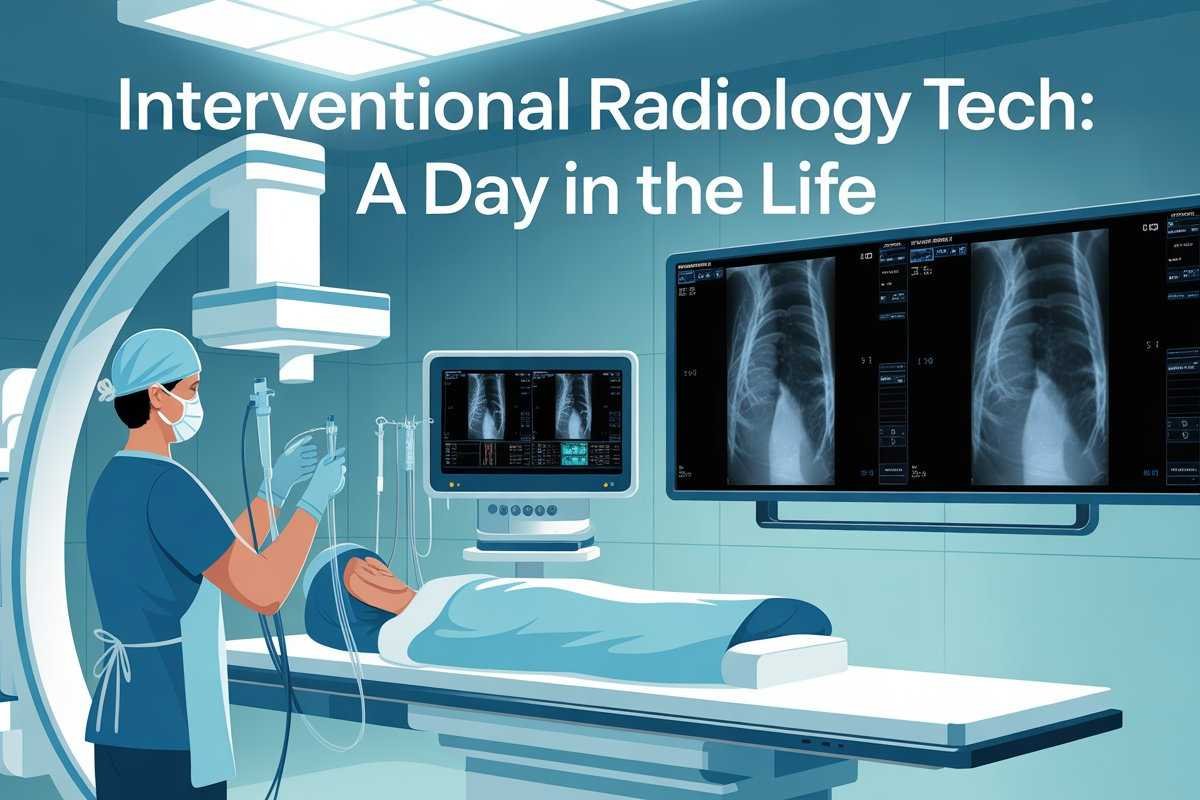
These procedures happen inside a specially equipped room called an Interventional Radiology Tech suite or cath lab. The room looks like a combination of an operating room and an imaging suite and that is exactly what it is. You will find a C-arm or biplane imaging system overhead, a flat panel detector for high-resolution imaging, a sterile procedure table, monitors everywhere and equipment for digital subtraction angiography (DSA), cone-beam CT and rotational angiography.
IR techs go by several names depending on the setting. You might hear the terms cardiovascular interventional technologist, vascular Interventional Radiology Tech radiographer or simply IR tech. All of these roles involve assisting in image-guided therapy using fluoroscopy, ultrasound-guided procedures, CT-guided biopsies and other advanced imaging techniques.
Step-by-Step: A Real Day in the Life of an Interventional Radiology Tech
Arriving Early and Reviewing the Schedule
Most IR techs arrive before the first case starts. The first thing you do is check the procedure schedule in the RIS (Interventional Radiology Tech Information System) and review the cases planned for the day. Today’s list might include an angioplasty, a nephrostomy tube placement, a TIPS procedure, and a uterine fibroid embolization all before noon.
You review each patient’s chart to check for allergies, kidney function (because contrast media can cause nephrotoxicity in patients with poor renal function) and any history of contrast reactions or anaphylaxis. You also check informed consent forms and confirm HIPAA compliance documentation is in order.
Tray Setup and Sterile Field Preparation
Next comes one of the most important parts of the job: tray setup. You put on your PPE gloves, gown and mask and carefully prepare the sterile field for each procedure. Instrument sterilization is critical here. Every guidewire, catheter, sheath, and balloon must be sterile and within its expiration date.
For an angiography case, you would set out contrast media syringes, a guidewire, multiple catheters, and a flush solution. For a drain placement or abscess drainage case, you would add a drainage catheter, locking pigtail, and collection bag. Getting tray setup right is non-negotiable mistakes here can delay the case or, worse, put the patient at risk.
First Case: Peripheral Angiography and Angioplasty
The first patient comes in with critical limb ischemia (CLI) a condition where the arteries in the legs are so blocked that the foot is in danger of gangrene. The patient has a diabetic foot and worsening wound care issues. The Interventional Radiology Tech radiologist plans to perform peripheral angiography to visualize the arteries, then angioplasty and possibly stent placement to open the blockage.
As the interventional radiology tech, you position the patient on the procedure table, connect the EKG monitoring leads, attach the oxygen saturation probe, and confirm blood pressure. You cover the patient with sterile drapes, leaving only the access site exposed. The physician uses vascular access to insert a sheath into the femoral artery, then threads a guidewire toward the popliteal artery, tibial artery and even the pedal artery.
You run the C-arm overhead and inject contrast media to capture real-time fluoroscopy images of the blood vessels. The DSA system removes background bone and tissue, leaving only a crystal-clear image of the arteries. You archive every image into the PACS (Picture Archiving and Communication System) as you go.
Once the blockage is found, the physician performs balloon dilatation inflating a tiny balloon inside the artery to push the plaque aside. Then comes stent placement, where a tiny metal mesh is deployed to keep the artery open. In some cases, atherectomy or even laser atherectomy tools shave the plaque directly.
Your job throughout all of this is to operate the imaging equipment, call out fluoroscopy times to monitor radiation dose, keep the sterile field intact and be ready to hand the physician any instrument they ask for.
Between Cases: Radiation Safety and Dose Monitoring
Between procedures, you take a moment to log the radiation dose data. IR techs follow the ALARA principle As Low As Reasonably Achievable which means you always try to minimize radiation exposure for both the patient and the team. You check your dosimeter and radiation badge, make sure everyone in the room is wearing their lead apron and thyroid shield, and document the fluoroscopy time from the last case.
Radiation safety is one of the most important and often overlooked aspects of this job. Dose reduction is not just a policy; it is something you think about with every move. Using low-dose protocols, collimating the beam and using the last image hold feature on the flat panel detector all contribute to protecting patients and staff. The NRC’s ALARA guidelines provide the regulatory framework that governs radiation protection in medical settings.
TIPS Procedure: The Complex One
The next case is a TIPS procedure transjugular intrahepatic portosystemic shunt. This is one of the most technically demanding procedures in Interventional Radiology Tech. The physician accesses the jugular vein in the neck, threads a catheter through the heart, into the portal vein inside the liver and creates an artificial channel to reduce pressure caused by liver disease. Navigating through the aorta, vena cava, and hepatic veins requires precision imaging at every step.
For this case, you are running biplane imaging two C-arms working simultaneously from different angles which gives the physician a 3D view of the anatomy. You use rotational angiography to create a roadmap, and the fusion imaging system overlays prior CT data onto the live fluoroscopy. This is 3D navigation at its finest.
Lunch (Maybe)
In IR, lunch is never guaranteed at a fixed time. If an emergency case comes in a GI bleed, a trauma embolization, or a postpartum hemorrhage lunch gets pushed. This is the reality of the job, and it surprises many new techs. Most IR teams are tight-knit, though, and everyone looks out for each other.
Uterine Fibroid Embolization (UFE)
In the afternoon, the team performs a uterine fibroid embolization a procedure where tiny particles are injected into the uterine arteries to block blood flow to fibroids, causing them to shrink. This is a life-changing procedure for many women and a great example of how IR offers minimally invasive alternatives to surgery.
For this case, you set up particle embolization supplies specifically embolic microspheres. After the physician uses arteriography to map the uterine arteries, they inject the particles under fluoroscopic guidance. Your job is to manage the contrast injections, monitor the patient’s vital signs, and document everything in the PACS and RIS systems.
Non-Vascular Cases: Drains, Biopsies and More
Not all IR work involves blood vessels. Later in the afternoon, the team handles non-vascular cases a CT-guided biopsy of a liver tumor, a nephrostomy tube placement for a patient with a blocked kidney and a biliary drainage procedure. These cases use CT, ultrasound-guided procedure techniques or fluoroscopy to guide needles and catheters into exact locations inside the body.
Sheath Removal, Hemostasis and Recovery Handoff
After procedures involving arterial access, someone must remove the sheath from the patient’s artery and achieve hemostasis stopping the bleeding. Depending on the site and the patient’s anticoagulation status, the physician or a trained tech uses manual compression, a closure device or both. This step requires careful monitoring of the puncture site for extravasation or pseudoaneurysm formation.
Once the patient is stable, you complete the recovery handoff transferring care to the recovery room nurses with a full verbal report on the procedure, contrast media used, conscious sedation or monitored anesthesia care (MAC) administered and any complications. Documentation in the RIS and PACS wraps up the patient’s record.
On-Call: When the Night Shift Calls
Many interventional radiology tech positions include on-call duties. This means you carry a pager or phone and must be able to arrive at the hospital within 30 minutes if an emergency case comes in. Common after-hours emergencies include stroke thrombectomy, pulmonary embolism treatment, DVT thrombolysis, trauma embolization and IVC filter placement.
On-call is one of the things no one fully prepares you for. You might be called in at 2 AM for a stroke thrombectomy where you need to scrub in immediately, spin up the biplane system and help save a person’s brain all while half-awake. It is intense, but for many IR techs, it is also the most rewarding part of the job.
What Procedures Does an Interventional Radiology Tech Assist With?
The range of procedures in IR is remarkably broad. Here is a comprehensive overview of what you might encounter:
Vascular Procedures
- Angiography and arteriography imaging of arteries throughout the body
- Venography imaging of veins
- Angioplasty and stent placement opening blocked arteries (carotid, renal, iliac, subclavian, SFA)
- Thrombolysis and DVT thrombolysis dissolving blood clots
- IVC filter placement and retrieval preventing pulmonary embolism
- AV fistula creation and dialysis access procedures
- Stroke thrombectomy and mechanical thrombectomy removing brain clots
- Aneurysm coiling and vascular malformation treatment
- PICC line and central venous catheter placement
- Pacemaker lead and ICD lead procedures
Embolization Procedures
- Uterine fibroid embolization (UFE)
- Prostate artery embolization
- Varicocele embolization
- Chemoembolization delivering chemotherapy directly to liver tumors
- Radioembolization with Y-90 microspheres (SIR-Spheres and TheraSphere)
- Trauma embolization and postpartum hemorrhage control
- Coil embolization, particle embolization, and glue embolization
- Mesenteric ischemia and GI bleed management
Tumor Ablation
- Radiofrequency ablation (RFA) using heat to destroy tumors
- Cryoablation using extreme cold to destroy tumors
- Tumor ablation for liver, kidney and lung nodules
Non-Vascular and Interventional Radiology Tech Pain
- Nephrostomy tube placement for kidney drainage
- Biliary drainage and gastrostomy tube placement
- Abscess drainage and drain placement
- Needle biopsy and CT-guided biopsy
- Vertebroplasty and kyphoplasty for spinal fractures
- Epidural steroid injection, nerve block, joint injection, and spinal injection
Advanced Imaging During Procedures
- Digital subtraction angiography (DSA)
- Intravascular ultrasound (IVUS)
- Optical coherence tomography (OCT)
- Fractional flow reserve (FFR) using a pressure wire
- Cone-beam CT and rotational angiography
- Fusion imaging and 3D navigation
- SBRT guidance and brachytherapy support including prostate seed implant with iodine-125 or iridium-192
How to Become an Interventional Radiology Tech
Step 1: Complete a Radiologic Technology Program
The first step is completing an accredited radiologic technology program, typically at the associate degree level. These programs take about two years and cover X-ray, fluoroscopy, patient positioning, radiation safety, contrast media, and basic patient care. You can find accredited programs through the American Registry of Radiologic Technologists (ARRT) the national body that sets certification standards for radiologic technologists in the United States.
Step 2: Pass the ARRT Radiography Exam
After graduating, you take the ARRT radiography examination to earn your R.T.(R) credential. This certification proves you have the foundational knowledge to work as a radiology technologist. Passing this exam opens the door to entry-level positions in hospitals, outpatient clinics and imaging centers.
Step 3: Gain Clinical Experience
Most IR tech employers want to see at least one to two years of general radiography experience before hiring someone into an IR role. During this time, you build your fluoroscopy skills, get comfortable with sterile technique and learn how a procedure room operates. Seeking out cross-training opportunities in IR at your facility is a smart move.
Step 4: Earn the ARRT Vascular Interventional Radiology Tech (VI) Credential
The gold-standard certification for IR techs is the ARRT Vascular Interventional Radiology Tech post-primary credential also written as R.T.(VI). This credential requires specific clinical experience requirements, structured education requirements and passing a comprehensive examination.
Some IR techs also pursue the RCIS (Registered Cardiovascular Invasive Specialist) credential for cardiac-focused work, or they specialize in neuro IR or pediatric IR.
Technologist Training and Continuing Education
Earning your credential is just the beginning. ARRT requires ongoing CME credits through continuing education every two years to maintain registration. Many IR techs attend simulation labs, participate in mock procedures, and complete peer review as part of their quality assurance obligations. Fellowship programs and IR residency pathways also exist for those who want to advance even further.
Interventional Radiology Tech Salary: What Can You Expect?
Quick answer: Experienced IR techs with VI certification often earn $80,000–$100,000+ per year in high-demand markets well above the median for general radiologic technologists.
One of the most common questions about this career is how much an IR tech earns. IR techs generally earn more than standard radiologic technologists because of the specialized skills required. According to the U.S. Bureau of Labor Statistics (BLS), radiologic technologists earn a median annual wage in the mid-to-high $60,000 range. Experienced IR techs especially those with VI certification and on-call responsibilities often earn significantly more.
| Factor | Impact on Salary |
|---|---|
| Hospital vs. outpatient setting | Hospitals typically pay more |
| Geographic location | High cost-of-living markets pay premium rates |
| On-call and overnight shift differentials | Can add $5,000–$15,000/year |
| ARRT VI certification | Directly increases earning potential |
| Years of experience | Senior techs earn near top of range |
Interventional Radiology Tech Jobs: Where Do You Work?
IR techs work in a variety of settings. Hospitals are the most common, particularly in the radiology department or dedicated Interventional Radiology Tech suite. Many large hospitals also have a hybrid OR where IR and surgery teams work together using advanced imaging during complex operations. Other settings include outpatient surgical centers, specialty vascular clinics and academic medical centers with IR residency and fellowship programs.
The job market for IR techs is strong. As populations age and demand for minimally invasive procedures grows, hospitals and clinics need more trained IR techs. Stroke thrombectomy programs, Y-90 radioembolization services, and peripheral artery disease clinics focusing on critical limb ischemia are all expanding rapidly. The Society of Interventional Radiology Tech (SIR) is an excellent resource for job listings, professional development, and industry news in the IR field.
The Multidisciplinary Team: Who You Work With Every Day
An interventional radiology tech never works alone. The Interventional Radiology Tech suite is a team environment that typically includes an interventional radiologist or physician, a scrub tech, a circulating tech, an IR nurse or nurse practitioner and sometimes a radiologist assistant. In cardiac or neuro interventional cases, the team may also include cardiologists, neurologists and anesthesiologists providing monitored anesthesia care (MAC) or conscious sedation.
Team communication is everything in this environment. When a contrast reaction happens, when a patient’s blood pressure drops, or when an emergency stroke thrombectomy arrives at midnight, every team member must know their role instantly.
What Makes a Great Interventional Radiology Tech?
Beyond technical skills, the best IR techs share some important qualities:
- Calm under pressure: emergencies are real and frequent
- Obsessively detail-oriented: a mis-labeled specimen or a missed allergy can have serious consequences
- Genuinely curious: IR technology evolves constantly, and the best techs keep learning through continuing education and peer review
- Patient-centered: even when procedures are routine for the team, they are often life-changing for the patient
- Workflow-focused: knowing how to set up trays faster, anticipate what the physician needs next and keep cases running on time
Technology Inside the IR Suite: What You Will Operate
- C-arm and biplane imaging systems for real-time fluoroscopy
- Flat panel detectors offering high-resolution imaging with low-dose protocols
- Digital subtraction angiography (DSA) for crystal-clear vascular imaging
- Cone-beam CT for 3D roadmapping during complex procedures
- Rotational angiography for multi-angle visualization
- IVUS, OCT, and FFR pressure wire systems for endovascular assessment
- Fusion imaging platforms that overlay CT or MRI data onto live fluoroscopy
- PACS and RIS systems for image archiving, retrieval and reporting
Radiation Safety for IR Techs: Protecting Yourself and Your Patients
Because IR techs work with fluoroscopy every day, radiation safety is a core part of the job. The ALARA principle (As Low As Reasonably Achievable) guides every decision in the suite. In practice, this means using dose reduction tools, collimating the X-ray beam to the smallest useful area, using the lowest frame rate that still produces a usable image, standing behind protective barriers when possible and always wearing your lead apron, thyroid shield, radiation badge and dosimeter.
Your dosimeter tracks your cumulative radiation exposure over time. Regulatory bodies and your hospital’s radiation safety officer monitor these records carefully. The RadiologyInfo.org patient safety resource produced by the ACR and RSNA explains how medical radiation is monitored and kept safe, which is useful reading for new IR techs as well.
Handling Complications: What IR Techs Need to Know
Not every procedure goes perfectly, and IR techs must be prepared for complications. The most common issues include contrast reactions ranging from mild hives to life-threatening anaphylaxis, nephrotoxicity in patients with kidney disease, extravasation (contrast leaking outside the vessel) and hemostasis challenges after sheath removal. Other complications that IR techs must recognize include sudden changes in vital signs, EKG abnormalities during cardiac procedures, and signs of vascular injury.
Specialized Tracks: Where Can an IR Career Take You?
After gaining experience in general vascular IR, many techs choose to specialize further:
- Neuro IR: stroke thrombectomy, aneurysm coiling and carotid stenting
- Oncologic IR: chemoembolization, radioembolization with Y-90 microspheres, and tumor ablation
- Pediatric IR: neonatal procedures and fetal interventions requiring additional training
- Radiologist Assistant: pursuing the R.R.A. credential for more clinical responsibility
- Education and management: quality assurance and department leadership roles
Interventional Radiology Tech Programs: What to Look For
When choosing an interventional radiology tech program or planning your path into IR, look for programs accredited by JRCERT (Joint Review Committee on Education in Radiologic Technology) for your foundational radiography training. JRCERT accreditation ensures that the program meets national standards for curriculum quality and clinical training.
After that, look for employers or facilities that offer structured IR training, simulation lab access and a clear pathway to earning your ARRT VI credential. Many hospitals offer internal cross-training programs where existing radiologic technologists can transition into IR. Academic medical centers with IR residency programs are especially good environments for learning.
Final Thoughts
A career as an interventional radiology tech is not for everyone but for the right person, it is one of the most rewarding jobs in all of healthcare. You will use advanced technology every day, assist in procedures that can save or transform lives, work as part of a close-knit multidisciplinary team, and never stop learning.
Yes, the on-call duties are challenging, the days can be long, and the learning curve is steep. But when you watch a blocked artery open up on the DSA screen or see a patient’s leg saved from amputation because of an angioplasty you helped perform that is a feeling that is hard to match.
If you are ready to start your journey, the first step is completing an accredited radiologic technology program and earning your ARRT radiography credential. From there, every procedure you scrub into, every case you document, and every certification you earn brings you closer to becoming a skilled and respected IR tech.
FAQs
What is the difference between an interventional radiology tech and a diagnostic radiology tech?
A diagnostic radiology tech takes images like X-rays or CT scans for diagnosis, while an interventional radiology tech actively assists in minimally invasive procedures using real-time imaging guidance.
Can an IR tech perform procedures independently?
No, an IR tech assists and supports the Interventional Radiology Tech but does not perform procedures independently; their role includes equipment operation, sterile field management, and patient monitoring.
What physical demands does an interventional radiology tech face?
IR techs stand for long hours, wear heavy lead aprons daily, and must move patients and equipment, making physical stamina and strength an important part of the job.
Is prior surgical or nursing experience helpful for becoming an IR tech?
While not required, experience with sterile technique, patient care, or procedural environments is highly beneficial and helps new IR techs adapt faster to the fast-paced suite.
How dangerous is radiation exposure for an interventional radiology tech?
With proper use of lead aprons, thyroid shields, dosimeters, and ALARA protocols, cumulative radiation risk is managed effectively, though long-term vigilance and monitoring remain essential.
What software systems does an IR tech use daily?
IR techs regularly work with PACS for image archiving, RIS for scheduling and documentation, and vendor-specific imaging platforms on fluoroscopy and DSA systems throughout every shift.
Can an interventional radiology tech specialize in only one type of procedure?
Yes, experienced IR techs often specialize in areas like neuro IR, oncologic IR, or pediatric IR, though most hospitals expect broad competency across vascular and non-vascular cases first.
What is the job outlook for interventional radiology tech over the next decade?
Demand is projected to grow steadily as aging populations increase the need for minimally invasive treatments for PAD, stroke, liver cancer and other conditions managed in the IR suite.