
The pace of change in the tech world has never been faster. Businesses, professionals, and entrepreneurs who understand where technology is heading are the ones who will lead, not follow.
That’s exactly why understanding the major trends in technology, especially through the lens of Togtechify, has become a strategic necessity rather than a nice-to-have.
Major trends in technology togtechify is a concept that goes beyond simple tech adoption. It describes the intelligent convergence, simplification, and unification of complex technology ecosystems into seamless, accessible, and high-impact solutions.
In this guide, major trends in technology togtechify we break down every critical emerging technology, explain its real-world impact, and show you how businesses of all sizes can apply these insights to grow, compete, and innovate in 2026 and beyond.
What are the major trends in technology togtechify? A Quick Primer
Before diving into the major trends in technology togtechify, it’s worth understanding what “togtechify” actually means in practice. At its core, Togtechify is the strategic act of integrating, streamlining, and democratizing technology, turning what was once a complex, siloed mess of tools into a cohesive, intelligent system that anyone in an organization can use effectively.
The major trends in technology to techify are not random innovations. They are directional forces, each one pushing toward a world where technology is faster, smarter, more unified, and more human-centered than ever before.
Top Major Trends in Technology Togtechify for 2026
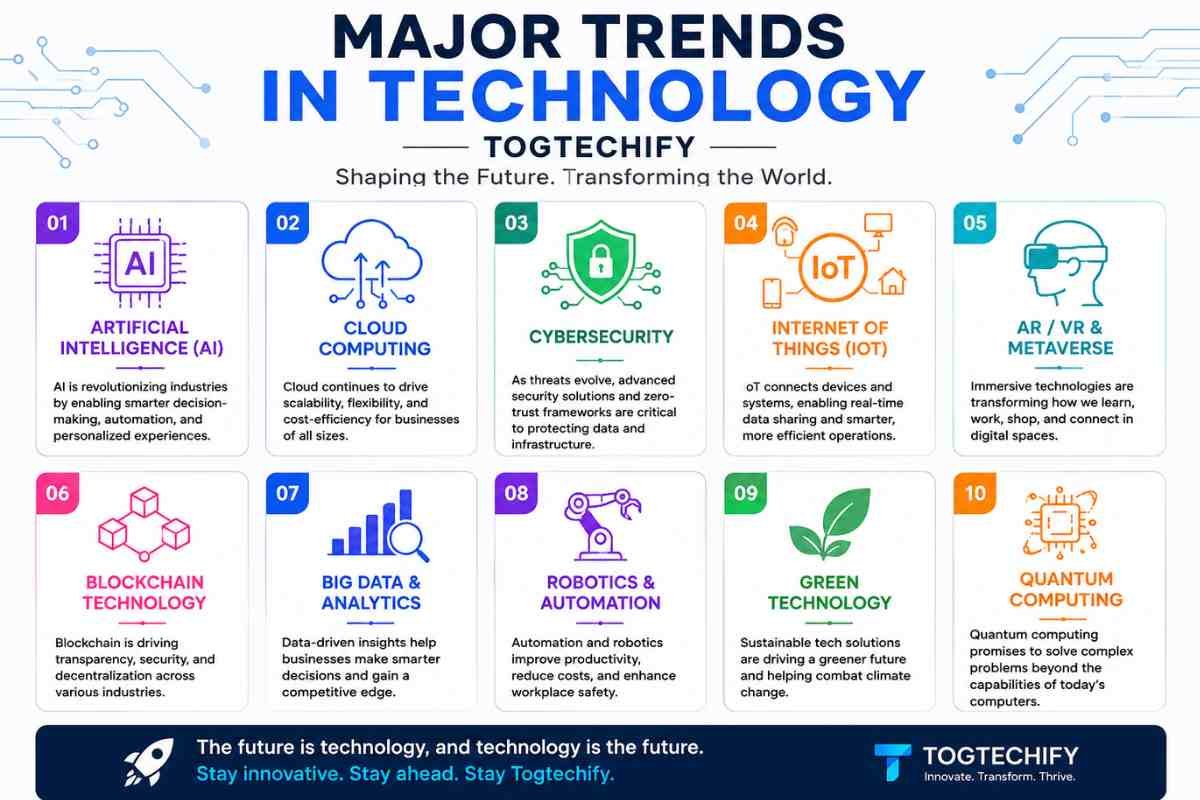
Artificial Intelligence and Machine Learning: The Brain Behind Everything
No conversation about modern technology trends is complete without artificial intelligence. AI has evolved from a research novelty into the operating system of the digital economy. In 2026, AI is embedded in supply chains, customer service, healthcare diagnostics, financial modeling, and HR strategy.
Machine learning specifically is powering predictive analytics at scale. Platforms like Google’s Vertex AI and Microsoft Azure AI are enabling companies to build custom models without deep data science expertise. Meanwhile, generative AI tools are transforming how content, code, and even product designs are created.
What makes AI a cornerstone of the tech-to-fy movement is its ability to act as intelligent glue connecting disparate systems, learning from data flows between them, and optimizing processes automatically. This is not the future. This is 2026.
Key impact areas:
- Talent management and HR analytics
- Predictive maintenance in manufacturing
- Personalized marketing and customer experience
- Real-time fraud detection in finance
Cloud Computing and Edge Computing: Speed Meets Scale
Cloud computing has long been a dominant force, but the latest technology trends show a critical evolution: the rise of edge computing. Rather than sending all data to centralized cloud servers, edge computing processes data closer to where it is generated on devices, local servers, or regional hubs.
This shift matters enormously for industries where latency is a life-or-death issue: autonomous vehicles, remote surgery, smart factories, and financial trading. Edge computing reduces response times from seconds to milliseconds.
Together, cloud and edge computing create a flexible, resilient infrastructure that underpins virtually every other trend on this list. Companies like Amazon Web Services (AWS), Microsoft Azure, and Google Cloud are investing heavily in hybrid architectures that combine the two.
Internet of Things (IoT) and Smart Devices: The Connected World Expands
The Internet of Things is no longer just about smart speakers and thermostats. In 2026, IoT encompasses smart factories (Industry 4.0), connected healthcare wearables, intelligent agricultural sensors, and city-wide infrastructure monitoring systems.
There are now over 16 billion connected IoT smart devices globally, with that number expected to exceed 25 billion by 2030. Each of these devices generates data, and organizations that know how to analyze and act on that data gain a massive operational edge.
In the context of TogTechify, IoT is a critical ingredient. It feeds real-time data into unified platforms, enables automation, and bridges the physical and digital worlds in ways that were simply not possible a decade ago.
5G Technology: The Backbone of Next-Generation Connectivity
The global rollout of 5G technology is quietly powering everything else on this list. With download speeds up to 100x faster than 4G and near-zero latency, 5G enables technologies that previously required wired connections to function wirelessly and at scale.
This is a top tech innovation that unlocks the following:
- Real-time remote operations (surgeries, equipment control)
- Mass deployment of IoT devices in dense urban areas
- Seamless augmented reality and virtual reality experiences
- Ultra-responsive autonomous vehicle communication
Countries like South Korea, the UAE, the United States, and China are leading 5G deployment, and businesses in these regions are already seeing the competitive benefits.
Cybersecurity and Data Security: Trust in a Hyper-Connected World
As digital connectivity deepens, so does risk exposure. Cybersecurity is one of the most critical AI technology trends of our era, with AI being used both to attack systems and to defend them. In fact, AI-powered threat detection is now the gold standard for enterprise security.
Data security is no longer just an IT department concern. It is a board-level, C-suite priority. With regulations like GDPR in Europe and growing data localization laws globally, organizations must embed security into every layer of their technology stack.
Quantum cryptography is emerging as the next frontier in data protection using the principles of quantum mechanics to create theoretically unbreakable encryption. Companies preparing for a next-generation technology future must begin quantum-readiness planning now.
Big Data Analytics: From Information Overload to Actionable Insight
We are living in a data economy. Every digital interaction generates data, and big data analytics is the discipline of making sense of it all. In 2026, advanced analytics platforms powered by AI and machine learning can process petabytes of data in real time, surfacing insights that would have taken human analysts months to uncover.
Major trends in technology togtechify organizations using data analytics effectively see measurable improvements in:
- Customer retention and lifetime value
- Operational efficiency and cost reduction
- Product development speed
- Market forecasting accuracy
The digital transformation trends most closely tied to competitive advantage all flow through data. Those who master big data analytics gain a view of their business and their market that competitors simply cannot match.
Blockchain Technology: Beyond Cryptocurrency
Blockchain technology has matured well beyond its cryptocurrency origins. In 2026, blockchain is transforming supply chain transparency, digital identity verification, smart contracts in legal and financial services, and healthcare data management.
The core value of blockchain, an immutable, decentralized ledger, makes it uniquely suited to industries where trust, traceability, and security are paramount. Companies like IBM (with IBM Blockchain), Walmart for food traceability, major trends in technology togtechify and Maersk for shipping logistics are already realizing tangible ROI from blockchain deployments.
Automation and Robotics: Redefining Work
Automation is one of the most consequential future technology trends for the global workforce. From robotic process automation (RPA) in back-office finance to advanced robotics in warehousing and surgery, machines are taking over repetitive, major trends in technology togtechify dangerous, and high-precision tasks.
This is not necessarily a story of job destruction. It is a story of job transformation. The major trends in technology togtechify philosophy recognizes that automation, done right, frees human talent for higher-order creative, strategic, and relationship-driven work. Companies like UiPath, Automation Anywhere, and Blue Prism are leading the RPA market, while Boston Dynamics and ABB are pushing the boundaries of physical robotics.
The major trends in technology togtechify key for businesses is not whether to automate but what to automate and how to reskill their people in parallel.
Virtual Reality and Augmented Reality: Immersive Experiences at Work and Play
Virtual reality (VR) and augmented reality (AR) have moved decisively from consumer entertainment into enterprise applications. In 2026, these technologies are used for:
- Immersive employee training (manufacturing, healthcare, military)
- Remote collaboration in 3D virtual workspaces
- AR-assisted maintenance and repair (workers see digital overlays on physical machines)
- Retail experiences that let customers visualize products in their own homes
Apple’s Vision Pro and Meta’s Quest series have pushed hardware capability and mainstream awareness. Meanwhile, enterprise platforms from companies like PTC (Vuforia) and Scope AR are embedding AR into industrial workflows with measurable productivity gains.
Quantum Computing: The Next Technological Leap
Of all the top technology trends in 2026, quantum computing represents the most profound long-term shift. Unlike classical computers that process bits (0 or 1), quantum computers use qubits that can exist in multiple states simultaneously, enabling them to solve certain classes of problems exponentially faster.
While still largely experimental for most businesses, quantum computing is advancing rapidly. IBM’s Quantum Network, Google’s Sycamore processor, and startups like IonQ are pushing the boundaries of what’s computationally possible. Major trends in technology togtechify industries poised for the earliest quantum advantage include pharmaceuticals (drug discovery), finance (portfolio optimization), and logistics (route planning at a massive scale).
Organizations’ major trends in technology togtechify should begin exploring quantum computing literacy now, even if deployment is still years away.
Green Technology and Sustainable Innovation
The digital transformation trends of 2026 cannot be separated from sustainability. Green technology encompassing renewable energy systems, carbon tracking software, sustainable data centers, and circular economy platforms is rapidly becoming both an ethical imperative and a business advantage.
Major tech companies, including Microsoft, Google, and Apple, have committed to carbon neutrality or negativity. Green data centers powered by renewable energy are replacing legacy infrastructure. And investors are increasingly factoring ESG (environmental, social, and governance) major trends in technology togtechify performance into capital allocation decisions.
Major trends in technology to transform in this context mean integrating sustainability intelligence into every layer of business operations, not treating it as a separate initiative but as a core dimension of major trends in technology togtechifydigital innovation.
How Businesses Can Act on These Trends Today
Understanding the major trends in technology togtechify in technology is only the first step. Here is a practical framework for turning insight into action:
Assess before you invest
Map your current technology stack and identify where the biggest inefficiencies, risks, and opportunities lie. This creates a strategic foundation for technology investment.
Prioritize by business objective
If your goal is operational efficiency, look at automation and cloud consolidation first. If competitive differentiation is the priority, explore AI and big data analytics. If workforce capability is the challenge, consider AR/VR training platforms.
Start with a pilot
Choose one trend and one department. Run a structured pilot, measure results rigorously, and use success to build internal momentum and executive buy-in.
Build digital literacy across the organization
The future technology trends we’ve covered require not just technological investment but also talent investment. Continuous learning, upskilling, and a culture of curiosity are as important as the tools themselves.
Embed ethics and security from day one
Every new technology introduces new risks. Data privacy, algorithmic fairness, and cybersecurity must be designed, major trends in technology togtechify not bolted on.
Conclusion
The major trends in technology togtechify are not abstract possibilities; they are forces actively reshaping industries, workforces, and competitive landscapes right now.
From artificial intelligence and cloud computing to quantum computing and green technology, these innovations are converging in ways that reward organizations that move thoughtfully and decisively.
The TogTechify philosophy offers a clear lens for navigating this complexity: integrate intelligently, simplify relentlessly, and put people at the center of every technology decision.
Whether you are a startup founder, a C-suite executive, an HR leader, or an IT professional, the latest technology innovations covered in this guide provide a roadmap for building a more agile, resilient, and future-ready organization.
The question is not whether these upcoming digital transformation trends will affect your industry. They already are. The major trends in technology togtechify question is whether you will shape that change or be shaped by it.
FAQs
What are the major trends in technology togtechify?
Major trends in technology include AI, cloud computing, IoT, cybersecurity, automation, blockchain, 5G, and quantum computing, shaping businesses in 2026.
What does togtechify mean?
Togtechify means simplifying and integrating modern technologies into one smart and efficient system.
Why are technology trends important?
Major trends in technology togtechify help businesses improve productivity, reduce costs, and stay competitive in the digital world.
How is AI changing businesses?
AI automates tasks, improves customer service, analyzes data, and helps companies make smarter decisions.
What is cloud computing?
Cloud computing allows businesses to store and access data and software online instead of physical servers.
What is edge computing?
Edge computing processes data near the device instead of a central server, making systems faster and more efficient.
How does IoT help industries?
IoT connects smart devices to collect real-time data for automation, monitoring, and better decision-making.
Why is cybersecurity important in 2026?
Cybersecurity protects businesses from data breaches, cyberattacks, and online threats as major trends in technology togtechify digital systems grow.