
When you first look at hockey, it seems like a game: the clock runs for 60 minutes, the game is divided into three periods, and then it is over. However, when you actually sit down and watch a hockey game, you will see that this is not the case.
The reason for this is not immediately clear. You have to take a look at how hockey works. Hockey games use a stop-time system, which means the clock stops a lot.
This guide is going to help you understand how long a hockey game really is. You will learn about the things that can affect how long is a hockey game lasts, and you will get some tips on how to plan your time whether you are watching the game in person, streaming it, or watching it on television.
How long is a hockey game, really?
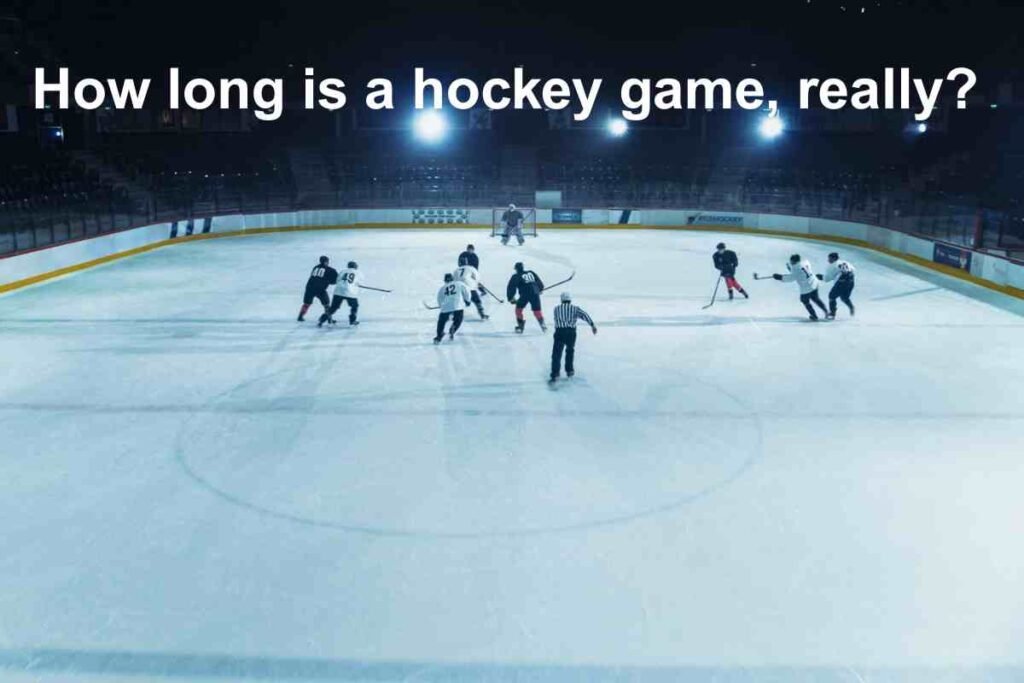
Here’s the short answer: a hockey game lasts about 2.5 to 3 hours in real time, even though the official game clock only shows 60 minutes of play.
That gap surprises almost every first-time fan. You buy tickets for what looks like a one-hour sport and walk out of the arena nearly three hours later. Where did the time go?
The answer lies in how hockey is structured: three periods, two intermissions, constant clock stoppages, and the always-looming possibility of overtime. Once you understand each piece, the total time of a hockey game, including breaks, makes complete sense.
This guide covers everything: NHL game length, college and youth hockey durations, field hockey game duration, real-time vs. how long is a hockey game, overtime rules, and practical tips for planning your viewing experience. Whether you’re how long is a hockey game beginner or a seasoned fan looking for the clearest breakdown available, this is the only guide you need.
The Basic Structure: How Many Minutes in a Hockey Game?
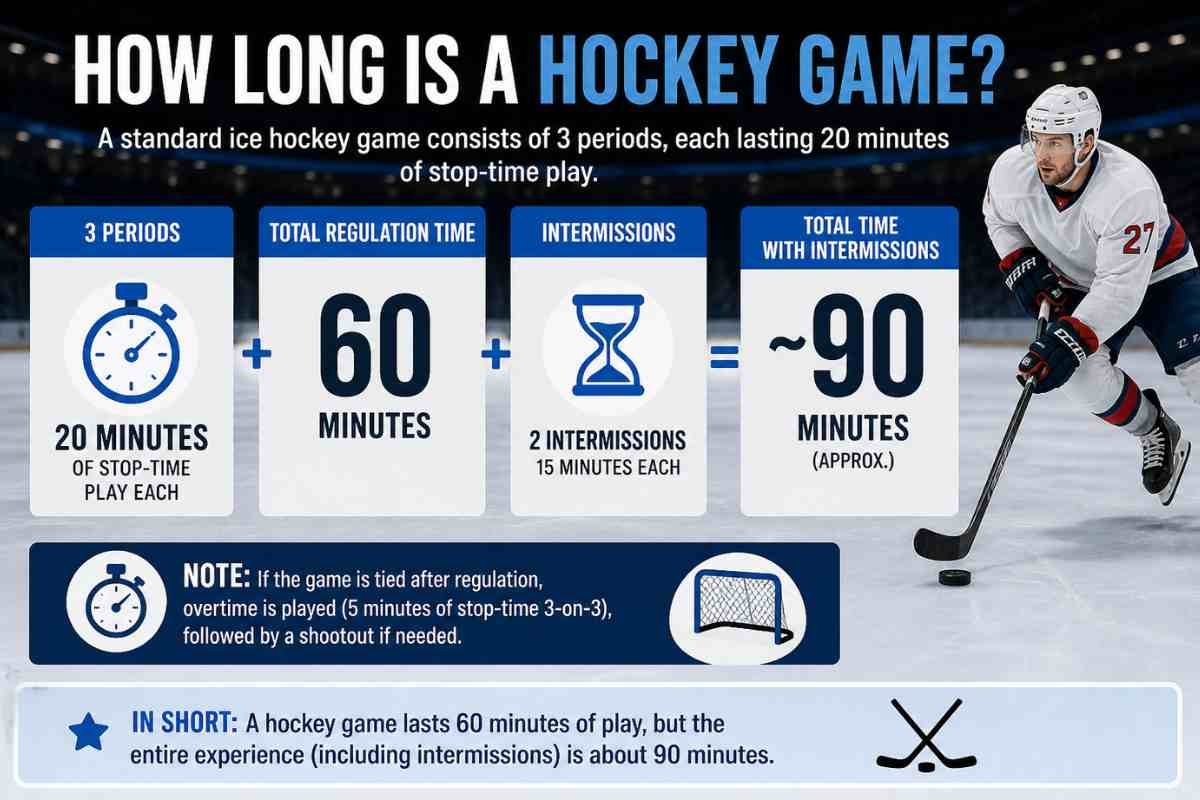
Let’s start with the foundation. A standard ice hockey game at the NHL, college, or most amateur levels is built around three periods, each 20 minutes long. That gives you 60 minutes of official play time, which is where the “one-hour sport” reputation comes from.
But here’s the thing: the clock stops constantly.
In hockey, the clock freezes every time the referee blows the whistle. Penalties, icing calls, goals, pucks over the glass, offside reviews, and goalie equipment checks all of it halts the game clock. In a typical NHL game, a single 20-minute period takes 35 to 45 minutes of actual real-world time to complete.
That’s the core of the real-time vs. playtime hockey equation. 60 minutes on the scoreboard clock does not mean 60 minutes on your watch.
Ice Hockey Game Time Rules: The Official Framework
According to NHL rules, the game is structured as follows: and with overtime it can extend by how long is a hockey game10 to 20 minutes, depending on whether a shootout is required.
- Period length: Three periods of 20 minutes each
- Clock behavior: Stop-time (clock halts on every whistle)
- Intermissions: Two breaks, one after each of the first two periods
- Overtime: Triggered when the score is tied after 60 minutes
Everything beyond those 60 minutes of hockey periods, the intermissions, the TV timeouts, the stoppages, and the overtime is what turns a one-hour sport into a three-hour event. How long is a hockey game? Discover the full breakdown of NHL game length, including 60 minutes of play time, intermissions, stoppages, and overtime, which can make games last 2.5 to 3 hours or more. .
Total Time of a Hockey Game Including Breaks
Here’s the full breakdown of where those extra hours come from:
Intermission Time in Hockey
After the first period and again after the second, both teams leave the ice for a break. In NHL games, each intermission lasts 17 to 18 minutes. That’s standard for regular-season and playoff games, though intermissions in playoffs are sometimes extended slightly to 18 minutes to allow for more complete ice resurfacing.
During that time, the ice crew resurfaces the rink using a Zamboni, players regroup in the locker room, coaches make adjustments, and broadcasters fill the airtime with analysis and highlights.
Two intermissions at 17–18 minutes each add roughly 34 to 36 minutes to the game before you’ve counted a single commercial break. How long is a hockey game?
TV Timeouts and Commercial Breaks
NHL games include three mandated TV timeouts per period, built-in commercial breaks that happen at the first stoppage after the 14:00, 10:00, and 6:00 marks of each period. How long is a hockey game? Each break runs about two minutes.
That’s up to 18 minutes of additional commercial time across a full game, nearly another full intermission.
Stoppages in Play
Beyond mandated timeouts, the clock stops constantly throughout each period. Every whistle freezes the game. Penalties, icing calls, goals, pucks fired into the crowd, injuries, video reviews for disputed goals, and coaches’ challenges all of it adds time.
A game with multiple penalties, a reviewed goal, or an injury can easily add another 10 to 20 minutes beyond what’s already accounted for. How long is a hockey game?
The Running Total
Add it all up:
| Component | Time |
| Regulation play (3 × 20 min) | 60 minutes |
| Two intermissions (17–18 min each) | ~35 minutes |
| TV timeouts (3 per period × 3 periods) | ~18 minutes |
| Stoppages, reviews, penalties | ~15–25 minutes |
| Typical Total | ~2 hrs 30 min – 2 hrs 45 min |
That’s the average hockey game length for a regular-season NHL game with no overtime. With overtime and a shootout, add another 10 to 20 minutes to how long is a hockey game.
Overtime in Hockey: How Long Does It Add?
The answer to “overtime in hockey, how long” depends entirely on whether it’s a regular-season game or a playoff matchup. The two formats are dramatically different, and they directly impact how long is a hockey game10 to 20 minutes longer in regular-season play, while playoff overtime can extend the game far beyond that with no fixed limit.
Regular Season Overtime
If an NHL regular-season game is tied after 60 minutes of regulation, teams play a 5-minute sudden-death overtime period in a 3-on-3 format. The first team to score wins the game ends immediately. This wide-open format generates a lot of goals, so most overtime games are decided within the first couple of minutes.
If nobody scores in that 5-minute window, the game goes to a shootout: each team selects three players for one-on-one attempts against the opposing goalie. If still tied after three rounds, the shootout continues in sudden-death rounds. The NHL eliminated ties in 2005, so every regular-season game produces a winner.
Total added time for regular-season overtime and shootout: 10 to 20 minutes. Most regular-season games that go to overtime, how long is a hockey game still wrap up within 2 hours and 45 minutes?
Playoff Overtime
Playoff overtime is an entirely different experience, one of the most intense situations in professional sports.
There are no shootouts in the NHL playoffs. There is also no time limit. If the game is tied after regulation, teams play complete 20-minute overtime periods at full 5-on-5 strength, with a full 15- to 18-minute intermission before each one. The game continues period after period, break after break, until someone scores. A single goal ends everything.
Games ending in the first overtime run about 3 hours total. Double overtime pushes to 3.5 hours. Triple overtime and beyond can push games past 4, even 5 hours.
The longest NHL game ever played was a 1936 playoff matchup between the Detroit Red Wings and the Montreal Maroons. How long is a hockey game? It lasted 176 minutes and 30 seconds of overtime the equivalent of nearly three full games. In the modern era, the 2000 Flyers vs. Penguins playoff game lasted five overtime periods, and Tampa Bay vs. Columbus in 2020 also went five overtimes during the bubble playoffs.
How Long Are Hockey Games at Different Levels?
The NHL is the benchmark, but hockey game duration varies significantly depending on the level of play. Here’s how the average how long is a hockey game length breaks down across formats.
NHL (Professional)
- Regulation: 60 minutes (3 × 20)
- Intermissions: Two breaks of 17–18 minutes each
- TV timeouts: Three per period
- Average duration: 2 hours 30 minutes to 2 hours 45 minutes
- With overtime: Up to 3 hours (regular season); potentially 4–5+ hours (playoffs)
College Hockey (NCAA)
College hockey uses the same three-period, 20-minute-each format as the NHL. The main differences:
- Intermissions run closer to 15 minutes (shorter than the NHL)
- Fewer commercial breaks and less broadcast infrastructure
- Overtime in non-conference games can end in a tie
- Some conferences use a shortened overtime followed by a shootout for a bonus standings point
Average duration: 2 hours to 2 hours 15 minutes, slightly quicker than an NHL game.
High School Hockey
High school games use three 15-minute periods rather than 20 minutes each. Intermissions are also trimmed to around 12 minutes.
Average duration: 1 hour 30 minutes to 2 hours. A noticeably shorter commitment, though the intensity on the ice doesn’t always reflect that.
Youth Hockey
Youth hockey is carefully structured to match age-appropriate stamina and attention spans.
- Mites (ages 5–6): ~30 minutes of running time with frequent line changes. Total time: 45–60 minutes.
- Squirts (ages 9–10): Three 12-minute periods, running or stop time depending on the league. Total: 50–70 minutes.
- Peewees (ages 11–12): Three 15-minute stop-time periods. Total: around 90 minutes.
- Bantams & Midgets (ages 13–18): Full three 20-minute periods. Total: 2 to 2.5 hours.
The progression in game length is intentional. It builds endurance gradually and prepares how long is a hockey game players for higher levels of competition.
Recreational (Adult League)
Recreational and “beer league” hockey is the most flexible format. Common setups:
- Three 15-minute running-time periods: The clock doesn’t stop on whistles, so the game wraps up in about 60 minutes of real time.
- Three 17-minute stop-time periods: Clock stops on whistles. Real-time runs 75 to 90 minutes.
Ice availability at rinks drives most of these decisions. How long is a hockey game? Recreational leagues need to fit multiple games per ice slot.
Field Hockey Game Duration
Field hockey shares a name with ice hockey but is a fundamentally different sport with its own time structure.
The modern field hockey format (adopted internationally in recent years) uses four quarters of 15 minutes each, for a total of 60 minutes of regulation play. Breaks between quarters run about 2 minutes, with a longer halftime of around 10 minutes.
Total field hockey game duration: approximately 1 hour 15 minutes to 1 hour 30 minutes. How long is a hockey game? It is much shorter than a professional ice hockey game and has far fewer stoppages since the clock often runs continuously.
Real Time vs. Play Time Hockey: Why the Gap Matters
Understanding the real-time vs. play-time hockey distinction isn’t just trivia; it’s genuinely useful for planning.
The gap between the 60 minutes on the scoreboard and the 2.5-plus hours in your seat is created by:
- A stop-time clock that freezes on every whistle (unlike soccer or basketball, which use running time)
- Structural breaks built into the format (intermissions are mandatory and long)
- Broadcasting obligations (TV timeouts are contractually required)
- Unpredictable events (injuries, video reviews, equipment issues)
This is also why hockey can feel simultaneously fast and long. The in-play action is genuinely fast; it’s the fastest team sport in the world in terms of player speed. But the total event duration stretches because of everything surrounding that action.
Knowing this gap helps you plan properly. Never assume a hockey game is over in an hour. Never book a dinner reservation 90 minutes after puck drop. And absolutely never assume a playoff, how long is a hockey game, will wrap up at a predictable time.
The “One Hour Per Period” Rule
The most reliable scheduling hack in all of hockey fandom is simple: budget one hour per period.
- One hour covers the 20 minutes of game time in the period
- Plus the 15 to 20 minutes of stoppages within that period
- Plus the intermission that follows it
For a 7:00 PM puck drop, that puts the final buzzer around 10:00 PM. It’s not a guarantee, but it’s a better planning tool than assuming the game ends at 8:00 PM because “it’s only 60 minutes.”
Tips for Attending a Game In Person
If you’re heading to the arena, a few things will make the experience significantly better:
- Arrive 30 to 45 minutes early. Pre-game warmups start 15 to 20 minutes before puck drop and are worth watching. Players skate at full speed, goalies warm up, and you get a sense of the atmosphere building.
- Actual puck drop is usually 10 to 15 minutes after the listed start time. National anthems, player introductions, and any special ceremonies happen after the gates open. A 7:00 PM listed start typically means a 7:10 to 7:15 PM puck drop.
- First intermission is the best time for concessions. Lines at the concession stand are longest during the second intermission. Get ahead of the crowd by grabbing food and drinks after the first period ends.
- Dress in layers. NHL arenas keep ice at roughly 22 to 24°F (−5 to −4°C), which means the air temperature for fans in lower seating can be noticeably colder than in the upper bowl. How long is a hockey game? Being able to add or remove a layer makes a big difference in a 3-hour event.
Tips for TV and Streaming Viewers
- Block 3 hours for regular-season games. This comfortably covers regulation, potential overtime, and a buffer.
- Block at least 3.5 hours for playoff games and be prepared for more. First-round series frequently go to overtime. Later playoff rounds make overtime feel almost routine.
- Set your DVR recording to end 30 to 60 minutes after the scheduled broadcast window. Broadcasters schedule conservatively, but a game going to multiple overtime periods will blow past any window.
- Streaming platforms (ESPN+, Sportsnet, DAZN) typically auto-extend their live streams, but check your platform’s settings if you’re wondering how long a hockey game recording is rather than watching live.
How Hockey Game Duration Has Evolved
Hockey’s timing structure has changed significantly over the sport’s history.
- Late 1800s: Games were played in two 30-minute halves
- 1910: The three-period format became standard
- 1942–1983: Regular-season games could end in ties (no overtime)
- 1983: Five-minute regular-season overtime was reintroduced
- 2005: The shootout was introduced, eliminating ties entirely
- 2015: Regular-season overtime switched from 4-on-4 to 3-on-3, dramatically increasing goal-scoring in overtime and reducing how often games reach the shootout
Each change pushed the game toward more decisive, exciting finishes while keeping total event duration manageable for fans and broadcasters. How long is a hockey game?
Quick Reference: Hockey Game Duration by Format
| Format | Period Length | Intermissions | Overtime | Total Real Time |
| NHL Regular Season | 3 × 20 min | 17–18 min each | 5 min (3-on-3) + shootout | 2.5 – 2 hrs 45 min |
| NHL Playoffs | 3 × 20 min | 17–18 min each | 20 min periods (no limit) | 3 – 5+ hours |
| NCAA College | 3 × 20 min | ~15 min each | Varies by conference | ~2 – 2 hrs 15 min |
| High School | 3 × 15 min | ~12 min each | Varies | 1.5 – 2 hours |
| Youth (Peewee) | 3 × 15 min | Short | Rarely | ~90 minutes |
| Recreational (Adult) | 3 × 15–17 min | Minimal | Rarely | 60 – 90 minutes |
| Field Hockey | 4 × 15 min | 2 min + halftime | Varies | ~1 hr 15 min – 1 hr 30 min |
Conclusion
So, how long is a hockey game? While the scoreboard shows 60 minutes of play, the real experience typically stretches to 2.5 to 3 hours once you factor in intermissions, stoppages, and possible overtime. And in high-stakes playoff situations, that timeline can extend far beyond expectations.
The key takeaway is simple: hockey is a stop-time sport, and that structure is what creates the gap between game time and real time. Whether you’re watching at home, streaming online, or heading to the arena, planning for the full experience, not just the clock makes everything run more smoothly.
From youth leagues to professional play, and even across to field hockey, game length varies, but the principle remains the same: the listed time never tells the whole story.
FAQs
How long is a hockey game?
A National Hockey League game typically lasts 2 hours 30 minutes to 2 hours 45 minutes in real time.
How long is a hockey game last with overtime?
In the regular season, overtime adds about 10 to 20 minutes, including a 5-minute sudden-death period and a possible shootout.
How long is each period in hockey?
Each period in ice hockey is 20 minutes of stop-time play at the professional and college levels. High school games usually have 15-minute periods, while youth leagues range from 12 to 15 minutes.
How long are intermissions in hockey?
Intermissions in NHL games last 17–18 minutes. College games typically have 15-minute breaks, and high school intermissions are around 12 minutes.
Why do hockey games last longer than 60 minutes?
Hockey uses a stop-time clock, meaning play pauses after every whistle.
How long is a hockey game field?
A field hockey match consists of four 15-minute quarters (60 minutes total).
How long do youth hockey games last?
Youth hockey duration varies by age.
- Mites (5–6): 45–60 minutes
- Peewee (11–12): Around 90 minutes
- Bantam/Midget (13–18): 1.5 to 2 hours
What is the longest hockey game ever played?
The longest NHL game took place in 1936 between the Detroit Red Wings and the Montreal Maroons.
How many periods are in a hockey game?
A standard ice hockey game has three periods. Each period lasts 20 minutes in most professional and organized leagues.
When should I arrive for an NHL game?
It’s best to arrive 30–45 minutes before game time. Warm-ups begin about 15–20 minutes before puck drop, which usually happens 10–15 minutes after the scheduled start.