
If you’ve ever tasted a cup of French press coffee, you already know it hits differently. Fuller body, richer flavor, and none of that papery aftertaste you sometimes get from drip machines. But if you’ve never tried it, you might wonder: how do I actually use a French press without messing it up?
This guide breaks down exactly how to use French press, step-by-step, whether you’re a total beginner or someone looking to refine their technique. By the end, you’ll know the right grind size, the ideal coffee-to-water ratio, the perfect steeping time, and the small tricks that separate a good cup from a great one.
What Is a French Press and Why Use One?
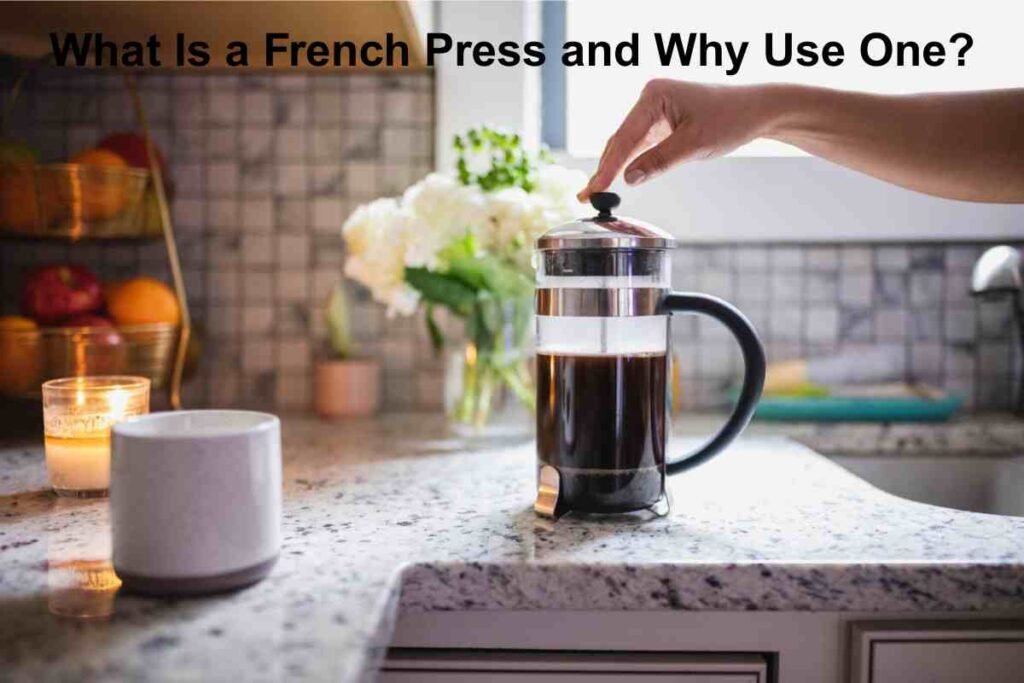
A French press (also called a coffee plunger or press pot) is one of the simplest and most effective coffee brewing methods in the world. It works by steeping coarse coffee grounds in hot water and then pressing a metal mesh filter down to separate the grounds from the liquid.
No paper filters. No electricity. Just how to use French press coffee, water, and a little patience.
French Press vs Drip Coffee
Drip coffee machines pass water quickly through fine grounds and a paper filter. The result is a clean, lighter-bodied cup but paper filters also strip out the natural oils that carry deep flavor. The French press brewing method keeps those oils intact, which is why how to use french press coffee tends to taste bolder and more complex.
French Press vs Espresso
Espresso is made under pressure using very finely ground coffee. It produces a concentrated shot with a thick crema. French press, on the other hand, uses a slower steep and produces a larger, full-bodied cup. Neither is “better” they’re just different experiences. The how to use french press is more approachable for home brewers since it requires no expensive machine.
French Press Coffee Benefits
- No need for paper filters or pods eco-friendly and cost-effective
- Full extraction of natural coffee oils = richer flavor
- Easy to control strength and taste
- Brews multiple cups at once
- No electricity required
What You Need Before You Start
Equipment Checklist
- A French press (any size 12 oz, 17 oz, or 34 oz)
- A kettle (a gooseneck kettle gives better pour control)
- A burr grinder (strongly recommended over blade grinders)
- A kitchen scale
- A timer
- A spoon or stirring stick
Best Coffee Beans for French Press
Not all coffee beans are created equal for this method. Look for:
- Medium to dark roasts these bring out the chocolatey, nutty, and caramel notes that shine in French press
- Single-origin beans great for exploring distinct flavor profiles
- Freshly roasted beans aim to use beans within 2–4 weeks of the roast date. Stale beans produce flat, lifeless coffee no matter how perfect your technique is
How to use french press Fresh coffee beans are the single biggest factor in cup quality. Technique can only take you so far if your beans are old.
How to Grind Coffee for French Press
This is where most beginners go wrong.
You need coarse coffee grounds. Think sea salt or breadcrumbs in size. Fine grounds will slip through the metal mesh filter, making your coffee gritty and over-extracted, resulting in bitterness.
A burr grinder gives you a consistent, even grind every time. Blade grinders chop unevenly, producing a mix of fine dust and large chunks that brews inconsistently.
Grind right before brewing. Pre-ground coffee starts losing flavor the moment it’s ground. Grinding fresh makes a noticeable how to use french press difference.
The French Press Coffee Ratio
Getting your coffee-to-water ratio right is essential to how to use French press coffee that tastes balanced, not weak, not overwhelmingly strong.
The standard French press coffee ratio is:
1:15 1 gram of coffee for every 15 grams (ml) of water
For practical use:
| French Press Size | Coffee (grams) | Water (grams/ml) |
| 12 oz (350ml) | 23g | 350ml |
| 17 oz (500ml) | 33g | 500ml |
| 34 oz (1L) | 67g | 1000ml |
How to use french press: Move toward a 1:12 ratio. Prefer something lighter? Try 1:17. These are starting points adjust to your taste.
Step-by-Step French Press Coffee Instructions
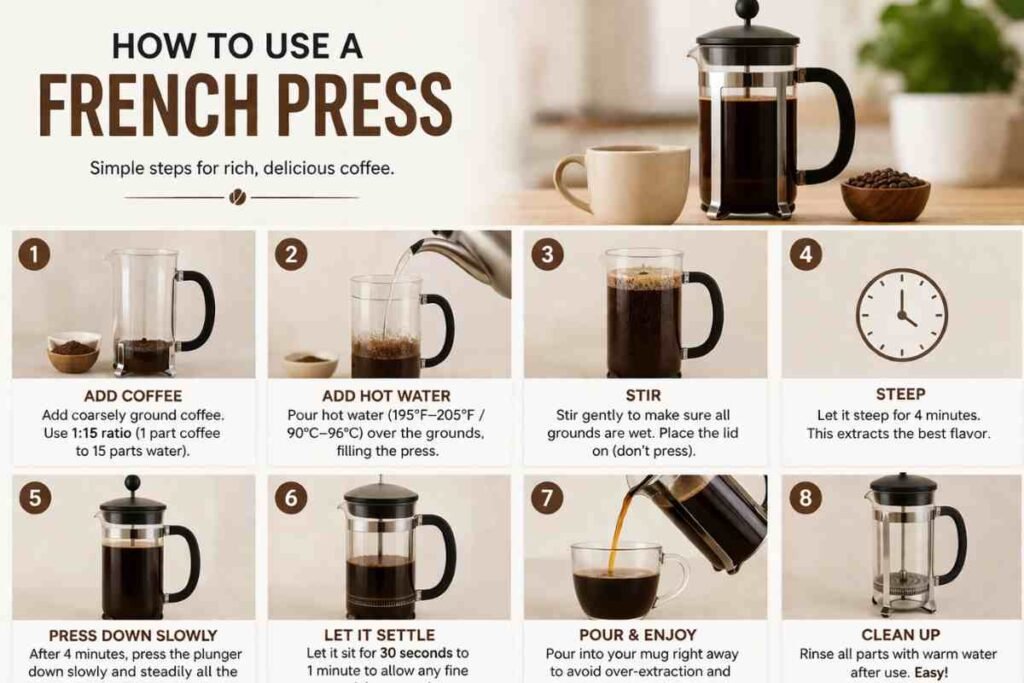
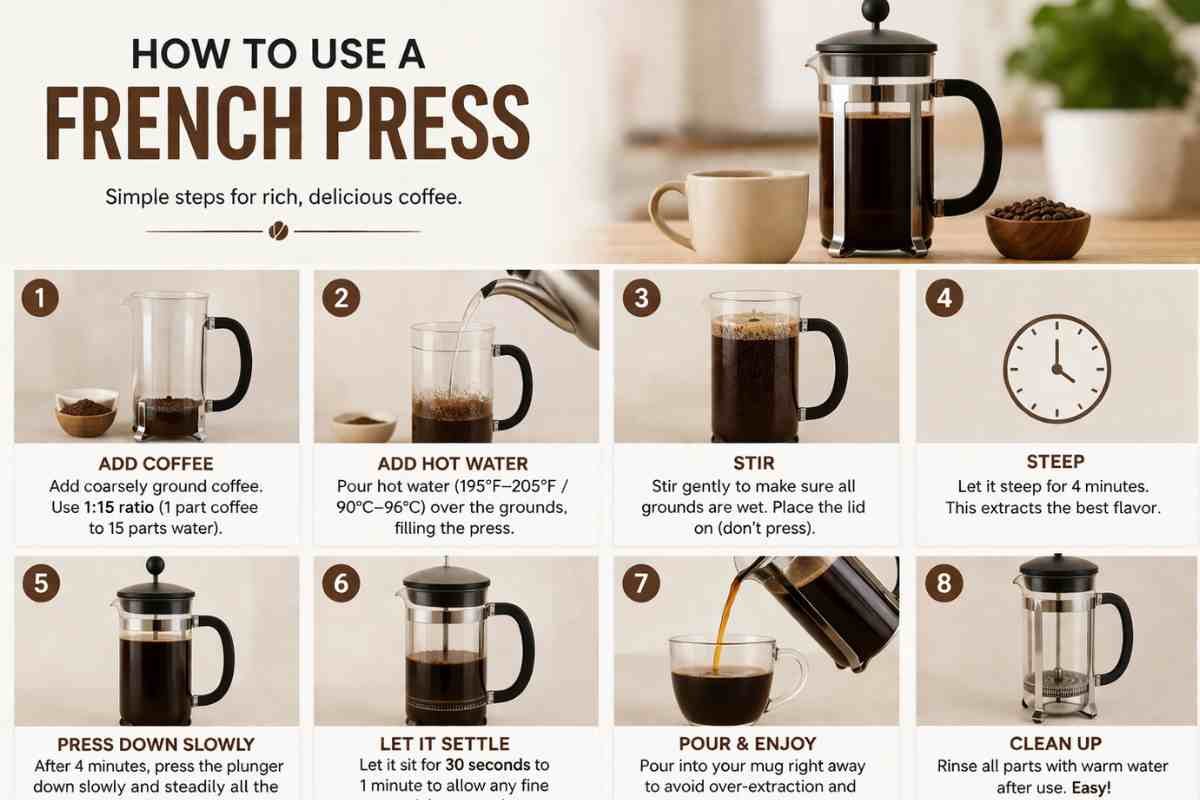
Here is the complete, foolproof how-to-use French Press guide:
Heat Your Water
Bring water to a boil, then let it sit for 30–45 seconds. The ideal water temperature for coffee in a French press is 90–96°C (195–205°F). Boiling water (100°C) is slightly too hot and can scorch the grounds, producing a bitter taste.
No thermometer? No problem. how to use french press: Simply boil and wait one minute before pouring.
Preheat Your French Press
Pour a small amount of hot water into your empty French press, swirl it around, and discard. This keeps the temperature stable throughout brewing and prevents your coffee from cooling too quickly.
Weigh and Grind Your Coffee
Weigh out your coffee (use the ratio table above), then grind to a coarse setting. Remember coarse like breadcrumbs, not fine like table salt.
Add Coffee Grounds and Bloom
Pour the coarse coffee grounds into the French press. Now, before adding all your water, do this:
The coffee bloom process: Pour just enough water to saturate all the grounds (about twice the weight of the coffee). Wait 30 seconds.
During this bloom, carbon dioxide trapped in fresh beans is released, which allows for more even extraction later. Skipping the bloom can result in uneven flavor.
You’ll often see the grounds puff up and bubble; how to use french press that’s a sign your beans are fresh.
Pour the Rest of the Water
After the bloom, slowly pour in the remaining hot water in a circular motion, making sure all the grounds are fully saturated. Put the lid on loosely with the plunger pulled up, do not press yet.
Steep for 4 Minutes
Set your timer for 4 minutes. This is the standard coffee brewing time for a French press. During steeping, the hot water extracts flavor, oils, and aroma from the grounds.
- Under 3 minutes = weak, under-extracted, sour
- 4 minutes = balanced, full-bodied
- Over 5 minutes = bitter, over-extracted
If you prefer a stronger cup, how to use french press use more coffee, not more steeping time.
Stir and Skim (Optional but Recommended)
After 4 minutes, gently stir the top crust of grounds that has formed. Then, using a spoon, skim off any foam or floating bits from the surface. This is the key step from James Hoffmann’s technique that results in a noticeably cleaner, less silty cup.
Want even less sediment? Wait an additional 3–5 minutes after stirring to let the remaining grounds settle to the bottom before plunging.
Plunge Slowly
Press the plunger down slowly and steadily. Apply even pressure. If it goes down too easily, your grind may be too coarse. If it’s very hard to push, the grind is too fine.
Important: Only plunge to just above the liquid level if possible, as this avoids disturbing settled grounds at the bottom.
Pour Immediately
Once plunged, pour your coffee right away. Leaving coffee sitting in the French press with the grounds continues the extraction process and will make your coffee bitter over time. If you’re not drinking it all at once, pour the remainder into a separate thermos or carafe.
Common French Press Mistakes (And How to Fix Them)
| Mistake | Why It’s a Problem | Fix |
| Using fine grounds | Creates gritty, bitter coffee | Switch to coarse grind |
| Boiling water directly | Scorches grounds, adds bitterness | Let water cool 30–45 seconds |
| Skipping the bloom | Uneven extraction, flat flavor | Always bloom for 30 seconds |
| Steeping too long | Over-extraction, harsh bitterness | Stick to 4 minutes |
| Leaving coffee in the press | Grounds keep extracting | Pour into a separate vessel immediately |
| Using stale beans | No technique can fix this | Buy fresh, use within 3 weeks of roast |
How to Clean a French Press
Cleaning your French press properly keeps it hygienic and ensures no old, stale oils contaminate your next brew.
After each use:
- Discard the grounds (into compost, trash, or your garden used grounds are great fertilizer)
- Rinse all parts with warm water
- Use a small brush or sponge to clean the mesh filter and plunger assembly
- Wash with mild dish soap
- Let all parts air dry before reassembling
Weekly deep clean: Disassemble the plunger completely (mesh filter, spring, plates) and soak in warm soapy water. Rinse thoroughly.
Avoid harsh abrasives, especially on glass carafes. And never bang a glass. How to Use French press against the trash can to empty it. It’s a guaranteed way to shatter it.
How to Brew Coffee with a French Press: Pro Tips
- Use filtered water: if your tap water tastes off, water makes up 98% of your cup
- Store beans properly: in an airtight container away from light, heat, and moisture. Avoid the fridge.
- Don’t overfill Leave: about an inch of space at the top for stirring
- Experiment with ratios: the 1:15 ratio is a starting point, not a rule
- Try a long steep cold brew: add cold water and steep in the fridge for 12–16 hours for smooth, how to use french press low-acid cold brew coffee
French Press vs Other Brewing Methods: Quick Comparison
| Method | Equipment Needed | Body | Ease | Cost |
| French Press | Press, kettle, grinder | Full, rich | Easy | Low |
| Drip Coffee | Machine | Medium, clean | Very easy | Medium |
| Espresso | Espresso machine | Concentrated | Moderate | High |
| Pour Over | Dripper, filters | Clean, bright | Moderate | Low–Medium |
| AeroPress | AeroPress device | Full to medium | Easy | Low |
Final Thoughts
Absolutely, and once you try it, you’ll wonder why you waited so long.
Learning how to use French press isn’t complicated. It comes down to four things: fresh beans, the right coarse grind, proper water temperature, and a 4-minute steep. Get those right, and you’ll consistently pull a rich, full-bodied cup that rivals anything from a coffee shop.
Yes, it takes a few more minutes than hitting a button on a drip machine. But that’s kind of the point. The French press brewing method is intentional. It slows you down, rewards a little attention, and gives you full control over your cup, something no pod or automatic machine can offer.
Whether you’re a first-time brewer or someone who’s been doing it wrong for years, this guide gives you everything you need. Start with the 1:15 ratio, nail your grind size, how to use french press respect the steep time, and pour immediately. Then adjust from there until it’s exactly the way you like it.
FAQs
How to use french press?
The standard steeping time is 4 minutes. Going much longer results in over-extraction and bitterness. If you want a stronger cup, add more coffee rather than extending the steep time.
What is the best coffee-to-water ratio for French press?
A 1:15 ratio is the standard starting point, which is about 33 grams of coffee to 500ml of water for a standard 17oz press. Adjust to how to use french press taste.
Why is my French press coffee bitter?
The most common causes are water that’s too hot, steeping too long, grinding too fine, or using stale beans. Start by checking your grind size and steeping time.
Can I use pre-ground coffee in a French press?
Yes, but make sure it’s labeled “coarse grind” or “French press grind.” Pre-ground coffee goes stale faster, so use it as fresh as possible.
Do I need to bloom my coffee in a French press?
It’s optional but highly recommended. The bloom releases CO₂ from fresh beans and allows for more even extraction, resulting in better flavor.
How do I get less sediment in my French press coffee?
Use a coarser grind, stir and skim after steeping, wait an extra 3–5 minutes for grounds to settle before plunging, and pour how to use french press carefully.
How often should I clean my French press?
Rinse and wash after every use. Do a full disassembly deep clean once a week to remove built-up coffee oils.