
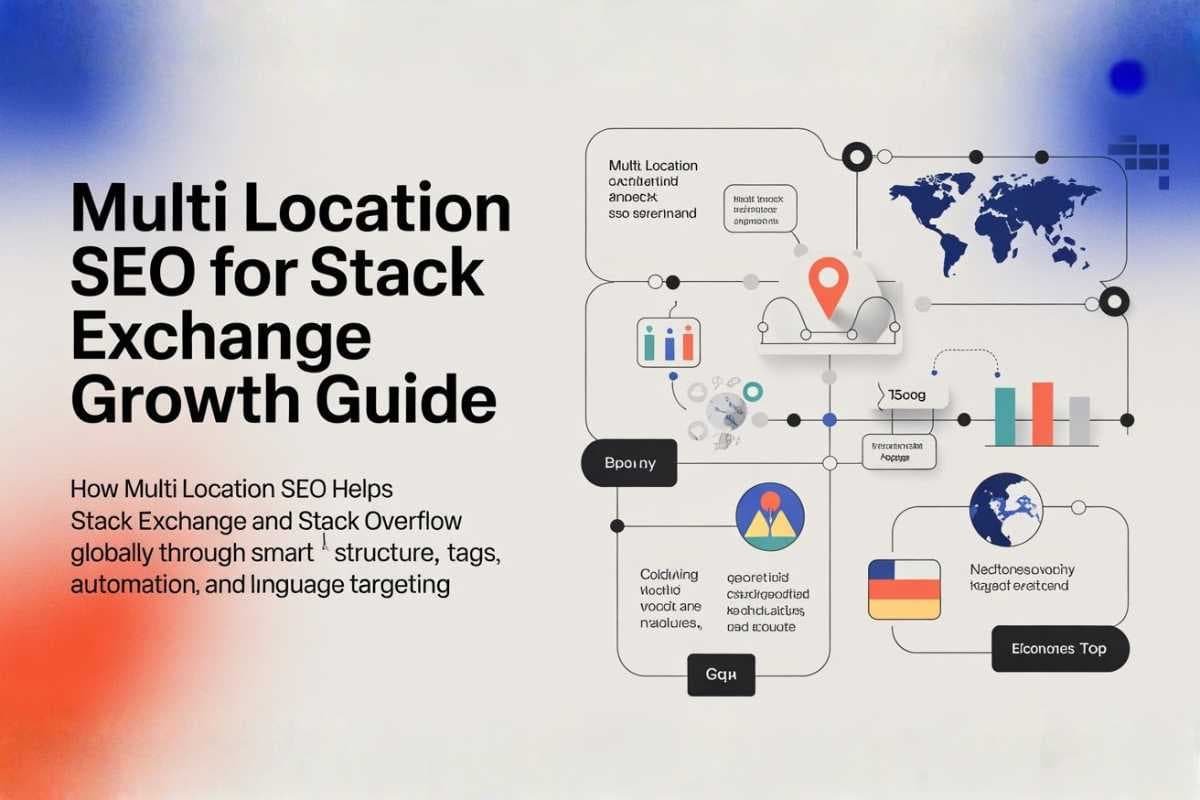
Multi location SEO is the strategy that allows large online platforms to rank across different geographic regions, languages, and search contexts at the same time.
For global communities like Stack Exchange Network and Stack Overflow, multi location SEO ensures that the right question, answer, or tag page appears for the right user based on their country, language preference, and search intent.
Whether someone searches in American English, British English, or another language variation, structured content and smart optimization help deliver the most relevant result.
If you’ve ever typed a programming question into Google and instantly landed on a helpful Stack Overflow page, that visibility is not accidental.
It is powered by strong site architecture, organized internal knowledge, automation systems, and carefully implemented multi location SEO strategies working together behind the scenes to improve rankings, user experience, and global reach.
Why Is Multi Location SEO Important for Stack Exchange Network and Stack Overflow?
Multi location SEO is essential for platforms like Stack Exchange Network and Stack Overflow because it allows large online communities to serve content across different countries, languages, and search variations without confusing search engines.
These platforms are not just a single website; they are a powerful network of exchange communities, each designed for a specific audience.
From English Language and Software Engineering to Mathematics and Server Fault, every exchange network site targets a unique group of users with specific search intent.
Without multi location SEO, Google would struggle to understand which page should rank for users searching in American English versus British English. Related questions, similar questions, and even hot network questions could lose visibility in different regions.
Since Stack Exchange Inc manages multiple domains and sub-communities, proper location targeting, structured URLs, smart tagging, and strong internal linking are critical.
Multi location SEO ensures that the right content reaches the right user, improving global rankings, user experience, and long-term organic growth across the entire network.
How Does Multi Location SEO Actually Work on a Community-Based Site?
Multi location SEO works on a community-based site through structured architecture, smart tagging systems, automation, and strong contextual signals that guide search engines.
On platforms like Stack Exchange Network, each community functions like a standalone word within a larger sentence.The entire network acts as one unified structure, while individual sites such as stackoverflow.com for developers, english.stackexchange.
com for English language discussions, and superuser.com for browser software and technical users maintain their own identity and focus.
This organized structure is a core part of multi location SEO because it helps search engines clearly understand context, topical relevance, and audience intent.
Through internal knowledge clusters, categorized tags, and clearly defined URLs, Google can recognize which content should rank for specific regions or user groups.
Just as the prefix multi- comes from the Latin quantifier multus meaning “many,” multi location SEO allows a site to send multiple ranking signals across locations.
Similar to multi-threaded software running several processes simultaneously, this strategy enables community platforms to rank efficiently in different geographic and language-based search environments.
How Do Tags, Questions, and Answers Support Multi Location SEO?
Tags, questions, and answers play a powerful role in strengthening multi location SEO by acting as internal location and context signals within a community-based site.
When users post a question, they add relevant tags that categorize the content and organize it into specific knowledge clusters.
These tags help related questions appear, improve semantic grouping, and strengthen internal linking across the platform.As a result, search engines better understand how topics connect within the broader exchange network.
For example, a question about the pronunciation difference between American English and British English may connect to tags like English pronunciations, Great Vowel Shift, Middle English, long vowels, or even Latin /ī/.
This structured clustering builds topical depth and authority, which directly supports multi location SEO by signaling relevance across language variations and regions.
Additionally, continuous user contributions under the by-sa license ensure fresh answers and updated knowledge.
This ongoing content growth improves rankings, strengthens trust, and helps online communities maintain long-term search visibility across multiple locations.
How Does Multi Location SEO Handle Multiple Languages and English Variations?
Multi location SEO ensures that the correct language variation appears for the right audience based on region, search behavior, and user intent.
For global platforms like Stack Exchange Network and Stack Overflow, this means understanding how English speakers search differently across countries.
For example, American English uses spellings like “color” and “organization,” while British English prefers “colour” and “organisation.”
A dictionary such as Merriam-Webster may standardize American English, but users in the UK or other regions naturally search using their own spelling patterns.
Through structured tagging, contextual signals, and language-based communities, multi location SEO allows platforms to support multiple languages and regional differences without confusion.
Stack Exchange communities handle pronunciation discussions, explain word differences in context, and address plural form and adjective variations clearly.
Instead of enforcing arbitrary rules, they focus on clarity and user intent.This flexible, language-aware approach strengthens global reach, improves search visibility, and ensures the right content ranks for the right audience across different English variations and locations.
How Do RSS Feed and RSS Reader Support Multi Location SEO?
RSS feed and RSS reader systems play an important role in strengthening multi location SEO by distributing content beyond the main site.
Platforms like Stack Exchange Network provide RSS feeds for each community, allowing users and RSS readers to follow hot network questions, track specific tags, and monitor focused topics easily.
This structured content distribution improves visibility across browser software, feed aggregators, developer tools, and even AI content systems.By expanding reach outside the primary domain, RSS feeds act as powerful distribution channels.
They reinforce search signals, increase content discovery, and support multi location SEO by ensuring knowledge reaches users across different platforms, regions, and search environments efficiently.
Does Automation and AI Play a Role in Multi Location SEO?
Yes, automation and AI are essential for boosting multi location SEO by helping large online communities manage content, improve relevance, and serve users across regions and languages.
Key contributions include:
- Detecting duplicate questions to maintain unique content and improve rankings.
- Suggesting similar questions to enhance internal linking and topical depth.
- Recommending related answers for higher user engagement and satisfaction.
- Organizing internal knowledge efficiently across tags and communities.
- Using AI models to match search intent and reduce irrelevant results.
- Supporting voice assistants and structured content for broader visibility and trust.
How Does Multi Location SEO Maintain Authority Across the Stack Exchange Network?
Multi location SEO helps maintain authority across the Stack Exchange Network through consistency, structured content, and user trust.
Stack Exchange Inc ensures a clear URL hierarchy, strong brand design, and recognizable logo identity, which signals professionalism and reliability to both users and search engines.
Verified user contributions, moderated teams, and contextual linking between communities further enhance credibility.
The network functions like a structured stack of Q&A layers, where each question becomes an initial object and each answer adds meaningful context.
Over time, this process builds a massive, internally connected knowledge graph, reinforcing authority and helping search engines recognize the platform as a trusted source across multiple locations, languages, and topics.
How Does Language History (Like Latin and the Great Vowel Shift) Relate to Multi Location SEO?
Language history plays an important role in multi location SEO by influencing search behavior, regional spelling, and pronunciation-based queries.
Users search differently depending on historical spelling, language evolution, and local pronunciation.
For example, the prefix multi comes from Latin multus, and long vowels shifted during the Great Vowel Shift, which is why English pronunciations vary today.
Multi location SEO takes these factors into account, considering word context, regional spelling, and language variations to ensure search engines correctly interpret intent.
Understanding language history helps platforms like Stack Exchange rank accurately across multiple regions and English variations.
How Do Stack Exchange Communities Avoid Duplicate Content Issues?
Stack Exchange communities prevent duplicate content problems through smart linking, tagging, and contextual signals that guide both users and search engines effectively.
When a similar question appears:
- Users are shown related questions
- Moderators merge duplicates
- Tags consolidate authority
- Answers redirect traffic
This prevents SEO dilution and strengthens topical depth.
Conclusion
Multi location SEO is the backbone of global online communities like Stack Exchange Network and Stack Overflow.
By combining structured site architecture, smart tagging, RSS feeds, and AI-driven automation, these platforms deliver relevant content to users across regions and languages.
Handling language variations, pronunciation differences, and historical spelling ensures search engines interpret intent accurately, while preventing duplicate content maintains authority and trust.
This strategy not only improves rankings but also enhances user experience, engagement, and topical depth.
Implementing multi location SEO effectively allows online communities to scale globally, strengthen visibility, and become trusted knowledge hubs for millions of users worldwide.
FAQs
What is multi location SEO?
Multi location SEO is a strategy that helps websites rank in different regions, languages, and search contexts simultaneously.
Why is multi location SEO important for Stack Exchange?
It ensures questions, answers, and tags appear to users in the right country and language, improving global reach.
How does site structure support multi location SEO?
Structured URLs, clear communities, and organized internal linking signal context to search engines efficiently.
How do tags and answers help SEO?
Tags categorize content, connect related questions, and strengthen internal linking for better topical depth.
Can multi location SEO handle language variations?
Yes, it supports American vs British English, multiple languages, pronunciations, and regional spelling differences.
How do RSS feeds improve multi location SEO?
RSS feeds distribute content beyond the site, increasing visibility in aggregators, browsers, and AI tools.
Does AI and automation affect SEO?
AI detects duplicates, suggests related questions, improves relevance, and organizes knowledge across communities.
How is authority maintained across Stack Exchange Network?
Authority comes from verified contributions, structured Q&A, moderated teams, and contextual linking across sites.